
The Blueprint for Trusted AI Operations
Govern AI at the Speed of Business
A structured engagement that gives leadership a clear operating model for AI, the key decisions resolved, and a prioritized path forward.
Ideal for organizations under AI scrutiny and leadership teams preparing to expand AI with greater control.
Current State
Fragmented AI Adoption
The Bridge
The Blueprint for Trusted AI Operations
Destination
Trusted AI Operations
Current State
Fragmented AI Adoption
The Bridge
The Blueprint for Trusted AI Operations
Destination
Trusted AI Operations
The Challenge
The Questions Leadership Must Be Ready to Answer
AI is already running across your organization, and many leadership teams are preparing to go further. Accountability arrives as questions.
The Blueprint prepares leadership to answer them.
What AI is operating today?
Who owns it?
What customer, audit, board, or regulatory questions must we be ready to answer?
What governance and controls exist today?
What evidence can we produce?
Where are the gaps that could affect trust, risk, sales, or scale?
The Blueprint is designed to answer these questions before the organization commits additional time, money, and executive attention.
The Five Workstreams
Inside the Blueprint

The Inputs
Design Basis
The Blueprint
Five Workstreams
- 1
Operational AI Alignment
- 2
Visibility and AI Landscape Management
- 3
Governance and Lifecycle
- 4
Runtime Controls, Human Authority, and Evidence
- 5
Secure AI Enablement and Adoption
The Destination
Trusted AI Operations
Operational AI Alignment. Who owns AI, what it is allowed to do, and how success is measured. Settled and written down.
Visibility and AI Landscape Management. What AI is running in your organization today, how it is being used, and how leadership maintains a clear view going forward.
Operational Governance and Lifecycle. How a new AI use case gets from idea to production, and what happens when something changes, breaks, or needs to be retired.
Runtime Controls, Human Authority, and Evidence. Where a human stays in the loop, how you intervene or contain a system, and the evidence you can show when asked.
Secure AI Enablement and Adoption. How employees use AI safely, what guidance and guardrails they get, and how adoption is tracked and supported.
The Deliverable
Leadership Walks Away in Control
You leave the engagement knowing exactly where your organization stands on AI, what to do first, and why. The Blueprint gives you a client-specific operating model, the critical decisions made and the open questions named, and decision-ready materials your teams can put to work immediately. It maps a prioritized first 90 days and sequences the six- and twelve-month direction, with dependencies, expected results, and investment clearly laid out. Your teams or partners execute; you hold the plan that tells them what matters most.
Client-specific operating model
Decisions made, open items named
Decision-ready supporting materials
Prioritized 90-day plan + 6- and 12-month roadmap
The Methodology
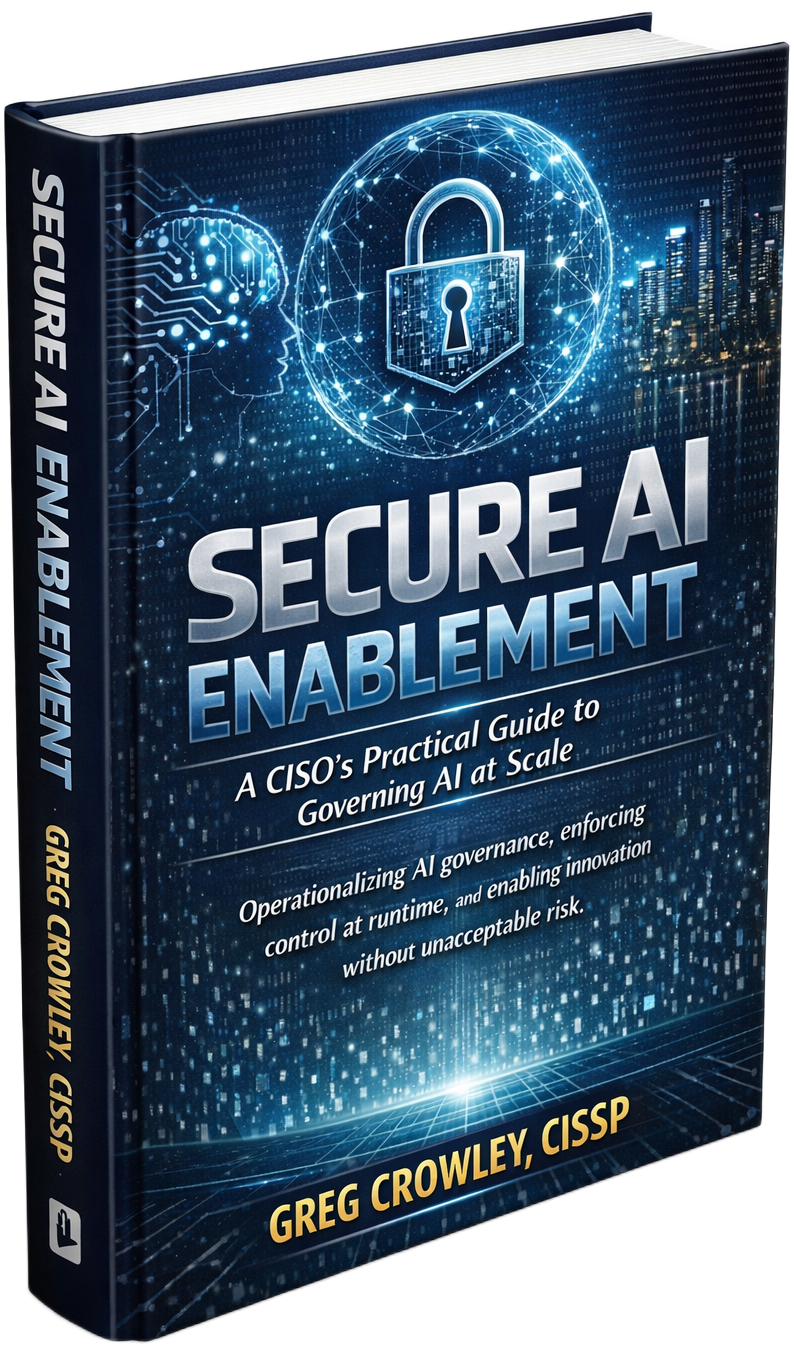
The Blueprint applies the Runtime Governance methodology developed by Greg Crowley, former enterprise CISO and author of Secure AI Enablement: A CISO's Practical Guide to Governing AI at Scale. Greg brings more than 25 years in enterprise security, risk, and technology leadership, including Board-facing and customer assurance experience. He personally leads every engagement, reviews the evidence, develops the operating model and roadmap, and approves every material recommendation. There is no junior handoff.
Explore the BookThe Engagement
Designed To Be High Value And Low Burden
4-6
Weeks Typical Duration
5-8
Stakeholder Interviews
4-5
Hours Executive Commitment
The engagement is intentionally designed to create meaningful outcomes while respecting leadership's time. Every engagement begins with an Executive Strategy Call, a no-cost conversation to confirm fit. From there, the Blueprint runs in four stages.
Understand the environment
Five to eight structured stakeholder interviews, review of existing governance, policies, and evidence, and one selected AI process or system review.
Design the company approach
Findings are synthesized into the client-specific operating model, and the decisions leadership needs to make are framed.
Resolve key decisions
One Executive Working Session where leadership works through the key decisions, priorities, and tradeoffs.
Finalize and brief leadership
The Executive Readout walks leadership through the Blueprint and the first ninety days of execution, followed by one controlled refinement cycle.
After the Roadmap
A Roadmap Only Creates Value When It Is Executed
The Blueprint stands on its own, and some organizations execute independently through internal teams or partners. As implementation moves forward, it creates new decisions about governance, controls, evidence, vendors, incidents, customers, and roadmap priorities. Runtime Executive Advisory provides ongoing executive guidance through those decisions.
Start With a Conversation
One call to find out if the Blueprint is the right next step.
The Executive Strategy Call is a focused discussion about your organization's AI use, the scrutiny or expansion decision ahead, and whether the Blueprint fits. No pitch, no pressure.