Trusted AI Operations for Organizations Under AI Scrutiny
Move From AI Adoption to Trusted AI Operations That Scale
AI adoption reaches an inflection point when customers, boards, and regulators want evidence your AI can be trusted. Runtime Executive helps you build Trusted AI Operations to earn that trust and unlock the business value AI was supposed to deliver.
A 30-minute conversation directly with Greg. No cost, no preparation, and no obligation.

Greg Crowley | Executive Advisor, Author of Secure AI Enablement
Who We Work With
Built for Organizations Moving Beyond AI Experimentation
Runtime Executive works with organizations that have already adopted AI and are now facing the challenges that come with scaling it.
Typical clients include CEOs, CIOs, CTOs, CISOs, governance leaders, and board-facing executives responsible for balancing innovation, risk, accountability, and business value.
The work is particularly relevant for organizations facing customer assurance requests, regulatory pressure, board scrutiny, or growing demands for visibility into how AI is being used across the business.
Runtime Executive is advisory-led. We design the operating model, control requirements, and evidence framework organizations need to govern AI effectively. We advise on implementation approaches, tooling decisions, and operating structures, but we do not build or sell software.
The Reality
AI Accountability Arrives Before Most Organizations Are Ready
Somewhere along the way, most organizations cross from AI experimentation into AI dependence. Copilots, agents, AI-enabled platforms, and employee tools now touch customer data, business decisions, and revenue. AI decisions carry business consequences.
That crossing has a cost. You are now expected to explain, defend, and prove how AI is being used. Customers are asking harder questions. Boards expect oversight. Auditors and regulators expect evidence rather than policy statements. Executives need confidence that AI is being used responsibly, securely, and effectively.
For most organizations, AI use is a settled fact. What remains unsettled is whether leadership can explain it, govern it, control it, and prove it.
Customer Trust
Customers are asking harder questions about how AI is used, governed, and controlled, and the organization struggles to answer with confidence.
Evidence
Auditors, regulators, and customers expect evidence rather than policies, and producing it remains difficult and time-consuming.
Board Confidence
The board expects oversight before AI becomes a material business or risk issue, and leadership lacks the fact-based view needed to provide it.
Ownership
AI initiatives are scaling across teams before ownership, governance, and operational control are ready.
Visibility
Security and GRC teams are asked to answer AI questions without reliable visibility into how AI is being used.
Risk & Control
AI tools, copilots, and agents are spreading across the business, and leadership lacks a clear view of what they touch, who owns them, and what risks exist.
Business Value
AI investment continues to increase while it remains difficult to show whether adoption is creating meaningful business value.
Operationalization
Everyone agrees AI matters, yet there is no clear path from adoption to governed, scalable, trusted use.
The Governance Gap
Policy Is Not Proof
Some organizations believe they have an AI governance program becasuse they have policies, committees, and approval workflows. Those matter, and they still fall short of proving that AI is operating within intended boundaries.
AI accountability requires more than governance intent. It requires visibility into actual AI use, control over meaningful decision points, clear ownership, and evidence that can withstand customer, board, and audit scrutiny.
Runtime Governance connects governance intent to operational reality so organizations can demonstrate how AI is being used, controlled, and trusted in practice.
The Key Differentiator
Governance Intent
Traditional Governance
Helps organizations establish policies, standards, roles, responsibilities, approval processes, and expectations for how AI should be used.
Operational Control
Runtime Governance
Connects those expectations to operational reality through Operational Runtime Controls that improve accountability, visibility, enforcement, and evidence generation during actual AI operation.
Governance intent without operational control is incomplete. Runtime Governance closes the gap.
Traditional governance defines how AI should be used.
Runtime Governance designs the operational controls and evidence needed to understand, govern, and validate how AI is actually being used.
The Bridge
The Bridge From AI Accountability to Trusted AI Operations
Unmanaged
AI Experimentation
- Shadow AI
- Experimentation
- Limited visibility
- No controls
AI Adoption
Accountability Inflection Point
- AI implemented
- AI diligence inquiries
- Answers expected
- Insufficient governance
- Business is at risk
The Bridge
The Blueprint
- Alignment
- Visibility
- Ownership
- Priorities
- Roadmap
Destination
Trusted AI Operations
- Operating model
- Reliable visibility
- Runtime controls
- Reliable evidence
- Governance at the speed of business
Unmanaged
AI Experimentation
- Shadow AI
- Experimentation
- Limited visibility
- No controls
AI Adoption
Accountability Inflection Point
- AI implemented
- AI diligence inquiries
- Answers expected
- Insufficient governance
- Business is at risk
The Bridge
The Blueprint
- Alignment
- Visibility
- Ownership
- Priorities
- Roadmap
Destination
Trusted AI Operations
- Operating model
- Reliable visibility
- Runtime controls
- Reliable evidence
- Governance at the speed of business
The Operating Model
The Path to Trusted AI Operations
Enabling Layer
Runtime Governance
Operational Runtime Controls connecting governance intent to operational reality.
Alignment
Business Direction
Visibility
Operational Awareness
Control
Operational Assurance
Evidence
Operational Proof
Trust
Confident Scale
Business Outcomes
What Trusted AI Operations Makes Possible
Protect and Grow Revenue
Organizations can pursue AI-driven opportunities while maintaining the trust required to win and retain enterprise customers.
Strengthen Customer Trust
Leadership can answer customer, partner, and stakeholder questions with greater confidence and evidence.
Improve Leadership Confidence
Executives gain visibility into AI use, governance, ownership, and operational accountability.
Scale AI Responsibly
AI initiatives can expand across the organization without sacrificing oversight, control, or trust.
The Engagement Model
How an Engagement Works
Step 01
Executive Strategy Call
A 30-minute conversation directly with Greg about your objectives, pressures, and current state. He'll explain how Runtime Executive approaches organizations like yours and give you a candid read on fit. If it's a fit, he'll recommend next steps. If it isn't a fit, he'll say so and point you in a better direction.
Step 02
The Blueprint
A focused engagement that builds your operating model, resolves key governance decisions, and delivers a prioritized roadmap toward Trusted AI Operations.
Step 03
Runtime Executive Advisory
Ongoing executive guidance as leadership navigates governance, customer assurance, vendor, and scaling decisions during execution.
Why Greg Crowley
An Experienced Voice in the Room When Decisions Matter Most
Greg has lived AI accountability from the inside. As CISO of a global cybersecurity company, he sat on the answering side of the table: responding to customer assurance questions, supporting audits, advising executives and the board, and making sure emerging technology adoption did not create unmanaged risk. Runtime Executive exists because more organizations are now arriving at that same moment.
"When I was the CISO, our prospects and customers started asking tough questions a policy document alone could not answer. I could see new regulations coming, and I knew our auditors would soon expect evidence, not assumptions. We had reached an inflection point where AI was part of our operations, and we were accountable for it. Most organizations are reaching that moment now. Runtime Executive was built for it."
Greg Crowley, Founder, Runtime Executive
Greg Crowley is an executive advisor, author, and enterprise security leader who has spent more than two decades helping organizations navigate complex technology, security, governance, and business transformation challenges.
As a board-facing executive, AI governance leader, customer advisor, and enterprise CISO, he has helped organizations navigate the realities of growth, customer trust, regulatory scrutiny, and emerging technology adoption.
His perspective is shaped by years of making consequential decisions in environments where revenue, customer trust, regulatory scrutiny, and organizational success were all on the line.
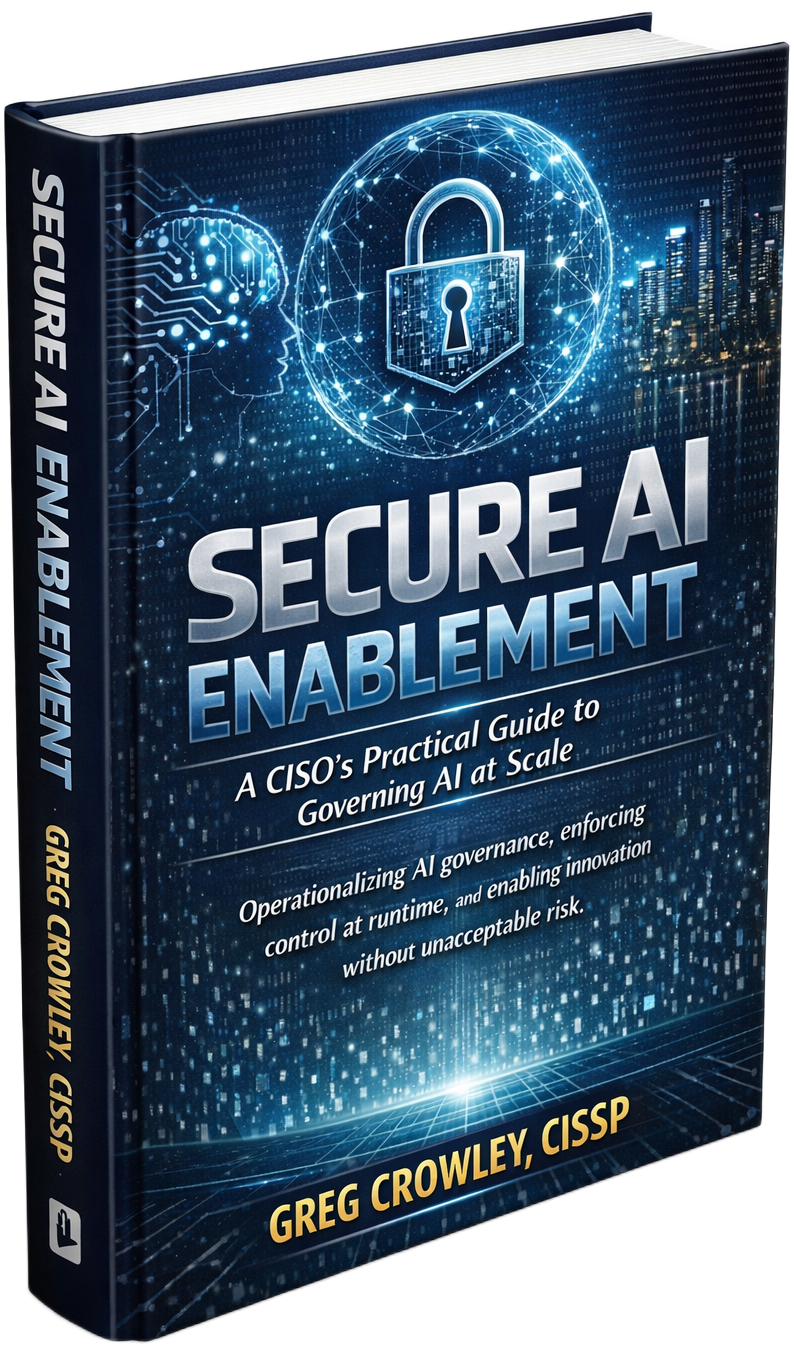
The Book Behind the Practice
Greg literally wrote the book on secure AI enablement.
"As a CISO, I watched AI adoption outrun governance inside my own organization and across every peer organization I compared notes with. Everyone had policies. Almost no one could prove what their AI was actually doing. It was new territory and there was no playbook, so I wrote one. Then organizations started asking for help putting it into practice, and Runtime Executive was born."
Greg Crowley
Secure AI Enablement: A CISO's Practical Guide to Governing AI at Scale is the foundation for the Runtime Governance methodology and the Blueprint for Trusted AI Operations.
25+ Years
Leading Security, Risk & Technology
Board-Facing Executive
Translating Risk into Business Decisions
Business Enablement Through Trust
Protecting Revenue & Accelerating Growth
Trusted Advisor
Executives, Founders & Investors
Enterprise Security Leader
Complex Global Environments
Next Step
Ready to Answer for AI?
An Executive Strategy Call is a focused conversation about your organization's AI adoption, the accountability pressure you are facing, and whether the path toward Trusted AI Operations is the right next step.
Founder, investor, or operator seeking focused advisory sessions? Explore Direct Access